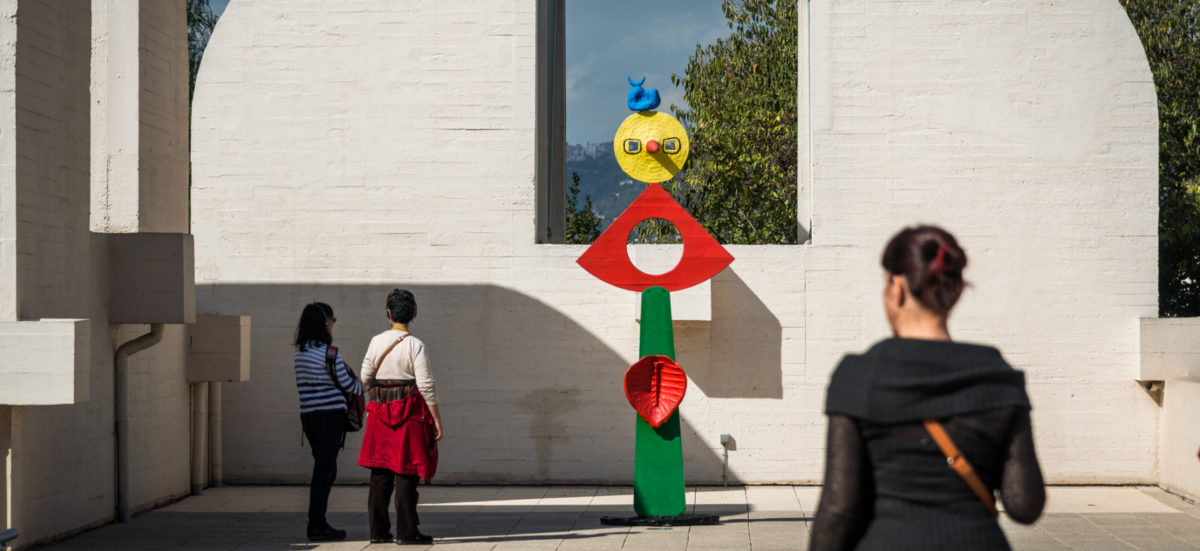
Between 25 February and 12 March, the Miró Collection galleries will remain closed for the installation of the upcoming exhibition Joan Miró. Circles. During this period you will be able to enjoy the exhibitions The Poetry Has Only Just Begun. 50 Years of the Fundació Joan Miró and ARNA by Huaqian Zhang at Espai 13, Open the Archive 07. L’Antitête exhibition, as well as the terraces with sculptures by Joan Miró and exceptional views of the city of Barcelona. In addition, free guided tours are offered every hour at the Fundació Joan Miró, included with your ticket.
The Fundació Joan Miró (Joan Miró Foundation) was set up to promote awareness of the work and personality of Joan Miró and to stage exhibitions of artists from the 20th and 21st centuries: an open door for exchanging ideas and disciplines that constantly looks towards the future while at the same time possessing both international prestige and deep roots in Catalonia.
The Fundació is housed in an exceptional building designed by the architect Josep Lluís Sert and can be found in the Parc de Montjuïc, which enjoys magnificent views over Barcelona, housing the world’s largest public collection of Joan Miró paintings.
The Fundació Joan Miró is a remarkable space created by Joan Miró himself with the idea of making art accessible to all people.
The collection of paintings, drawings, sculptures and works on paper displayed in the Fundació is one of the most comprehensive selections of Miró’s oeuvre, offering a thorough overview of all the stages of his life and career.
A variety of spaces allow visitors to venture into an interdisciplinary exploration of the highly personal language and production of one of the most influential artists of the 20th century. A series of overarching themes illustrate key concepts in Miró’s work and the thinking of his times
HIGHLIGHTS
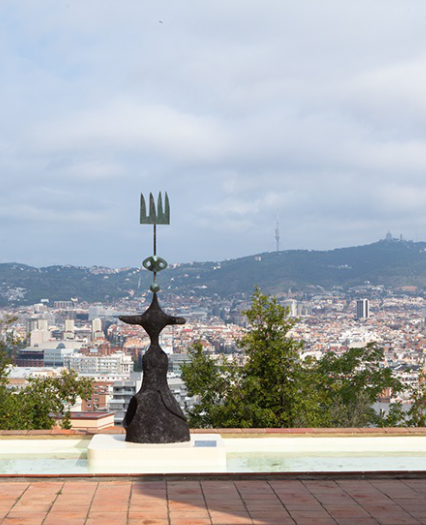
VIEWS FROM PATI NORD
An outstanding balcony over Barcelona that enjoys one of the most privileged views of the city. Surrounded by Sert’s rationalist architecture and Joan Miró’s work.
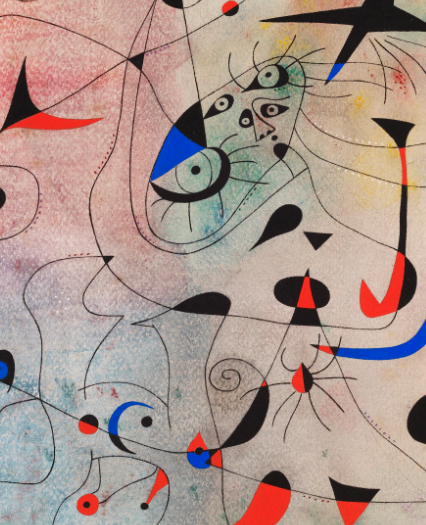
MORNING STAR
In the late summer of 1939, one month before the outbreak of the Second World War, Miró moved to Varengeville-sur-Mer, in Normandy, hoping to escape from the harsh circumstances surrounding…
In the late summer of 1939, one month before the outbreak of the Second World War, Miró moved to Varengeville-sur-Mer, in Normandy, hoping to escape from the harsh circumstances surrounding him. A period of seclusion would help his process of introspection, in which the night sky with its celestial bodies played an essential role.
“Constellations”, a series of twenty-three washes on paper, seemingly attempts to represent the entire order of the cosmos, with weightless figures relating to the Earth and sharing their universe with a large number of celestial signs.
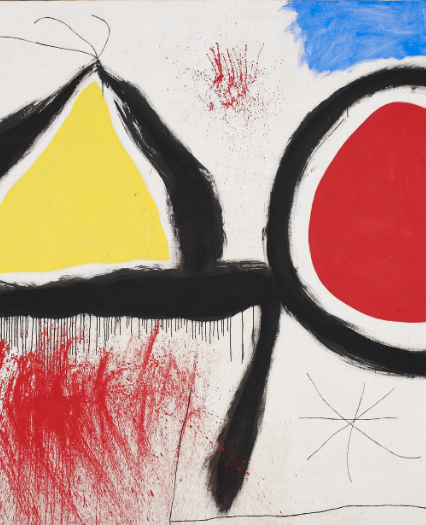
FIGURE IN FRONT OF THE SUN
Figure in Front of the Sun displays the controlled gesture that distinguishes Miró’s painting in the late 1960s, an expressive freedom with no clear precedent in his work, but with…
Figure in Front of the Sun displays the controlled gesture that distinguishes Miró’s painting in the late 1960s, an expressive freedom with no clear precedent in his work, but with an undeniable compositional rigour. Black is the point of departure employed by the artist to outline and structure the painting. The incorporation of other colours is governed by divisions and empty spaces. In spite of its spontaneity, Miró never neglects the composition: the elimination of any one element would destroy the overall balance.
Black is the point of departure, employed by the artist to outline and structure the painting. The incorporation of the other colours is governed by the divisions and the empty spaces.
In spite of his spontaneity, Miró never neglects the composition: the elimination of any one element would destroy the overall balance.
FOUNDATION TAPESTRY
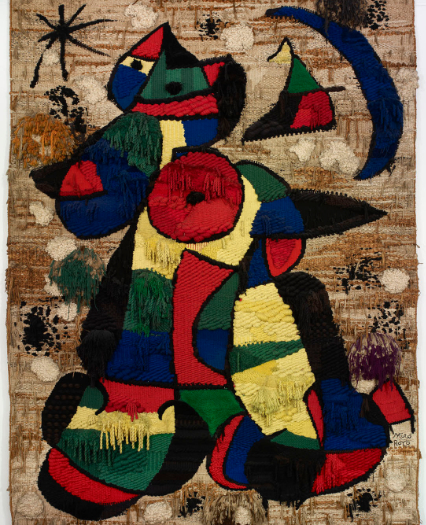
In 1972, in collaboration with Josep Royo, Miró produced his first textiles known as “sobreteixims”, which were a mix of painting, collage and tapestry. A year later, when he received…
In 1972, in collaboration with Josep Royo, Miró produced his first textiles known as “sobreteixims”, which were a mix of painting, collage and tapestry. A year later, when he received commissions for monumental tapestries in New York and Washington, he also produced one for the Fundació. Transferring a pictorial language to a medium such as tapestry, with its own specific difficulties, called for an adjustment that was primarily materialized in the expressive use of textures.
To provide the best experiences, we use technologies like cookies to store and/or access device information. Consenting to these technologies will allow us to process data for functional, statistical or ad personalization purposes. Not consenting or withdrawing consent, may adversely affect certain features and functions.
Functional Always active
The technical storage or access is strictly necessary for the legitimate purpose of enabling the use of a specific service explicitly requested by the subscriber or user, or for the sole purpose of carrying out the transmission of a communication over an electronic communications network.
Preferències
The technical storage or access is necessary for the legitimate purpose of storing preferences that are not requested by the subscriber or user.
Statistics
The technical storage or access that is used exclusively for statistical purposes.The technical storage or access that is used exclusively for anonymous statistical purposes. Without a subpoena, voluntary compliance on the part of your Internet Service Provider, or additional records from a third party, information stored or retrieved for this purpose alone cannot usually be used to identify you.
Personalization of ads
The technical storage or access is required to create user profiles to send advertising, or to track the user on a website or across several websites for similar marketing purposes.